Shear Friction Capacity (Interface Shear)
This calculation determines the shear friction capacity of concrete at a crack or joint
 CSA A23.3-19
Resistance factor for concrete
Resistance factor for reinforcing steel
Specified concrete strength
Specified reinforcing steel yield strength
Concrete density modification factor; 1.0 for normal density concrete
Area of reinforcing crossing the shear plane
Axial load; compression positive
Slab / member thickness
Effective width of cross section
The type of surface at the interface. If no surface prep has been performed, choose plain. Intentionally roughened surface requires hardened concrete to be cleaned and mechanically roughened to an amplitude of at least 5 mm (1/4 inch). Steel surface requires headed studs. It is not intended for smooth steel-on-concrete joints.
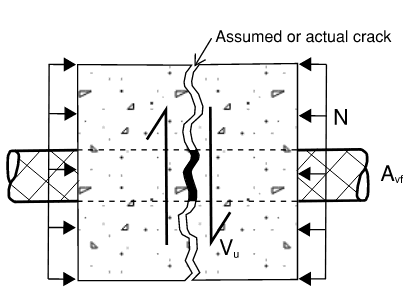
Calculation Steps:
- Surface type = Intentionally roughened
- c = 0.50 MPa = 0.0725 ksi
- μ = 1
- p_v
Reinforcing ratio
- σ
Normal stress on the interface
ksi - v_rmax
Maximum permissible shear stress per CSA A23.3 Cl. 11.5.1
ksi - V_rmax
Maximum permissible shear force
kip - v_r
Shear friction stress capacity per CSA A23.3 Cl. 11.5.1
ksi - V_r
Shear friction capacity
kip